
The operators capturing the most revenue in 2026 share a single discipline: they treat approval rate as the highest-leverage number on the payments dashboard, not a reporting metric. The ones using premium payment orchestration to close the gap between intent and completed deposit are pulling ahead of those still writing off declines as a cost of doing business.
Oxford Economics has the cross-industry number: merchants in the US, UK, France, and Germany lose $50.7 billion a year to false declines, up roughly 140% since 2019. The number runs higher in iGaming. Deposit frequency and player lifetime value both tie directly to whether the transaction goes through, and issuers apply extra scrutiny to iGaming transactions. Every approval you recover at signup keeps paying out across that player's lifetime.
Three things in the deposit funnel decide how much of that gap closes.
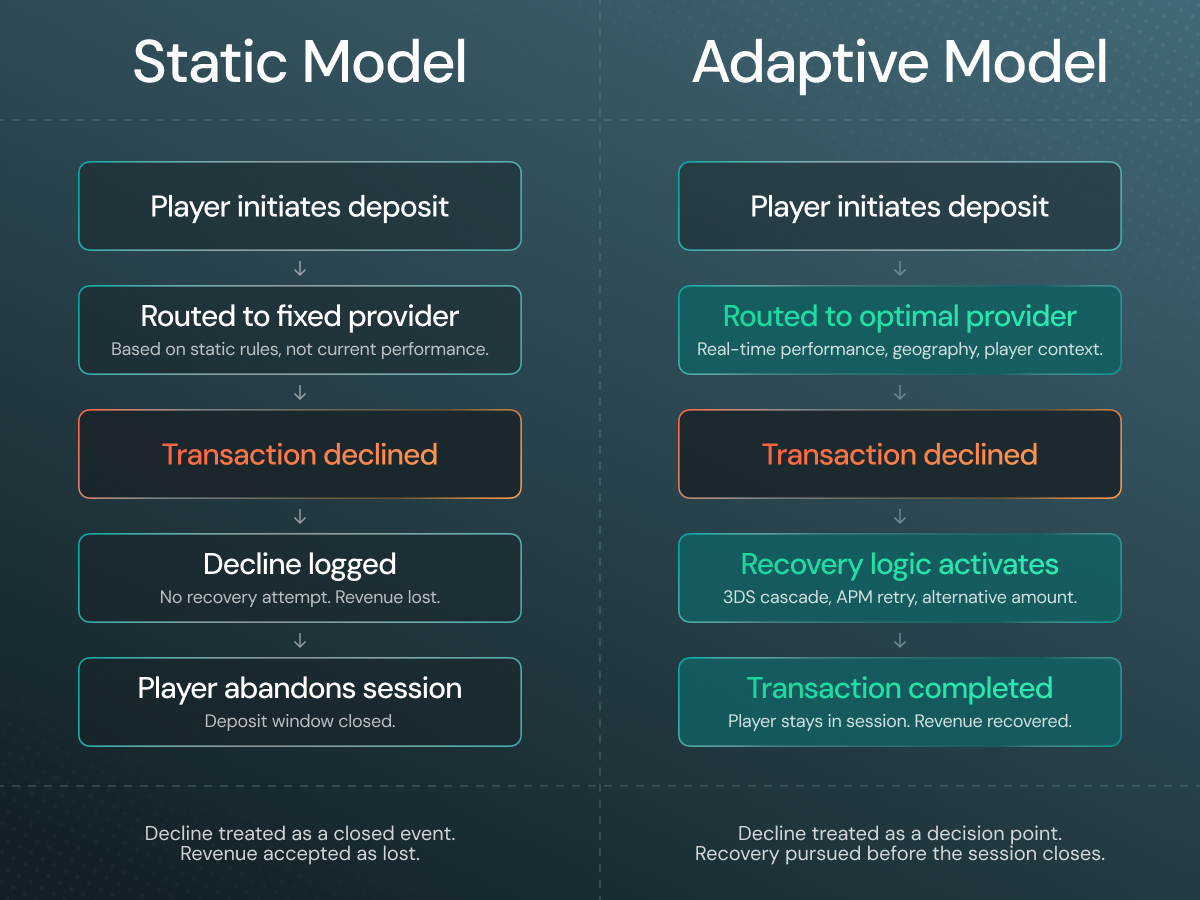
Static routing sends transactions to providers based on rules that were right when they were set, and slowly stop being right as providers change, new markets open, and player behavior shifts. In an adaptive model, every transaction is evaluated at the point of processing against:
The platform routes to the provider most likely to approve that specific transaction right now, not the one that looked best on average last week. When a provider starts underperforming in a market or during a particular time window, the routing logic executes against the criteria in place, directing transactions away from underperforming providers based on the rules configured for that market. Approval rates hold as conditions change rather than drifting down silently while the team waits for a manual fix.
A static stack treats a declined transaction as the end of the story. An adaptive one treats it as the next step. The decline recovery layer includes multiple mechanisms designed for different failure types.
For authentication failures, approaches like 3DS cascading retry the transaction through an alternative flow without forcing the user to start over. For boundary issues like insufficient funds or temporary deposit limits, alternative amount suggestions keep the user moving forward within the same session.
These are examples of how the recovery logic responds to specific decline types, the broader capability covering a range of scenarios depending on the provider payment method in the market context.
The recovery layer runs in the background, without adding friction to the player and without asking them to try again. The transactions it catches are the ones a static stack would have logged and moved on from.
Showing a player the wrong payment method, or the right one in the wrong order, adds friction at the moment they are most ready to deposit. Baymard Institute research finds that 13% of shoppers abandon a checkout entirely when their preferred payment method is not available. In iGaming, where the deposit moment carries the full cost of acquiring that player, every abandoned checkout multiplies the marketing spend you have already paid.
The closer the checkout reflects how a player actually pays in their market, the higher the completion rate. Pix in Brazil, iDEAL in the Netherlands, and Interac in Canada are not nice-to-haves; they are how players in those markets actually pay. Operators that present them in the right order by jurisdiction win meaningfully more of the funnel than those running a one-size-fits-all default.
PGWAY’s optimization layer does not force a trade-off with the existing user experience or front-end design. Whether it runs as a drop-in checkout widget or integrates with a proprietary stack via a modular API, the orchestration logic operates the same way behind the scenes, protecting the deposit funnel without requiring changes to what the user sees or how the operator’s team manages the front end.
Platform logic alone does not close the approval rate gap. Most orchestration providers hand over a set of tools and leave the operator to figure out the right setup for their market, their player base, and their provider mix. That is an internal capability that is expensive to build and slow to keep current.
PGWAY works differently. The platform sits behind a dedicated configuration team that treats your approval rate as its own North Star. The team tunes the routing logic based on how issuers behave across multiple operators in your market, spots provider performance dropping before any single in-house team would catch it, and adjusts the order of payment methods using fresh data from the full 300+ provider ecosystem. The tuning runs continuously, not as a quarterly review.
The fine-tuning PGWAY applies to your routing logic draws on signals from across the full operator network, which is what turns incremental optimization into a compounding advantage.
A one-point gain in approval rate is a percentage of a growing base, which means the financial impact compounds as volume grows. Operators who make the shift to active optimization with PGWAY early build a widening lead against those still treating declines as a fixed cost.
The data effect speeds this up. PGWAY running optimization across multiple high-volume operators at once sees transaction patterns, provider behavior, and market-specific recovery outcomes that no in-house team can match. That pooled view gets more valuable as operator volume grows, not less. The routing intelligence that PGWAY applies to your setup is informed by signals from across the network, not just your own transaction history.
Continuous optimization through PGWAY does not add infrastructure cost. The architecture is built on enterprise-grade security, with PCI-DSS Level 1 and ISO/IEC 27001 certifications and a documented 99.99% uptime guarantee. Volume scales without the platform getting in the way.
The shift from reactive monitoring to active revenue optimization is where the compounding advantage begins.
See how PGWAY optimizes approval rates across your provider mix.


.svg)

Get in Touch


